
Zoom
The dominant video conferencing platform for businesses, now expanding into an AI-first work platform.
Quick take
Zoom is the Toyota Camry of video conferencing: reliable, widely supported, and not exciting. The competition (Teams bundled with M365, Meet bundled with Workspace) wins on price for organizations already in those ecosystems. But on pure meeting quality and ecosystem depth, Zoom remains the benchmark. The RTMS API is the most interesting recent development, giving developers a native alternative to meeting bots.
Zoom scorecard
How we gradeThe default video platform, now an AI-first work suite.
Overview
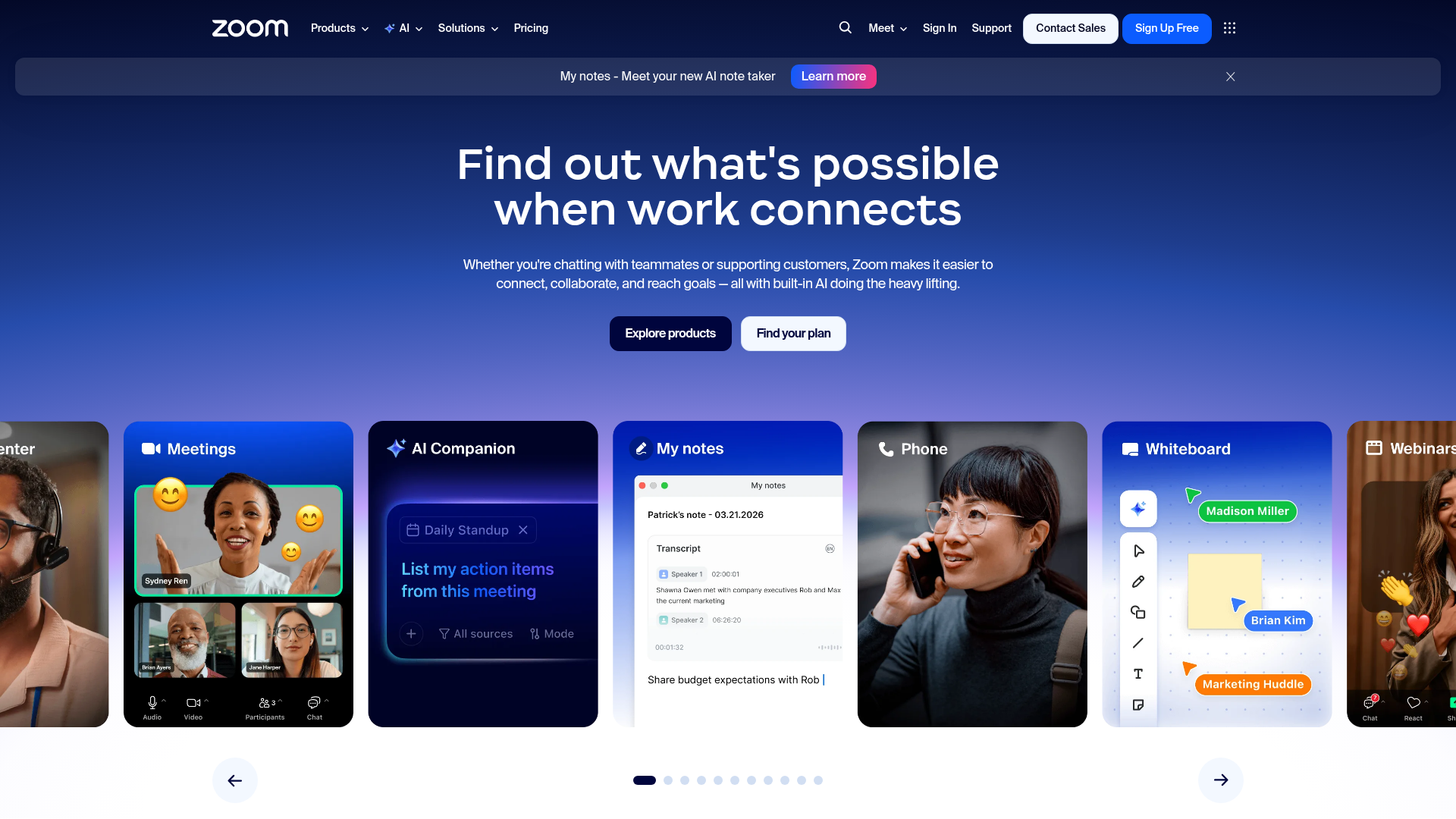
Zoom needs no introduction. It is the default video conferencing platform for most of the world, with over 300 million daily meeting participants and a brand name that became a verb during the pandemic. Zoom Workplace (the rebrand from Zoom Meetings) now includes AI Companion features, live transcription, meeting summaries, and Zoom Clips for async video. With 55,990 G2 reviews at 4.5/5, it is the most reviewed meeting tool in existence. The company went public in 2019, peaked at $160B market cap in 2020, and has since stabilized as a profitable, mature platform.
Strengths & limitations
Strengths
- +Industry standard with massive adoption
- +Reliable at scale
- +Rich ecosystem of integrations
Limitations
- –AI features require paid plans
- –Zoom fatigue is a real brand issue
- –Security concerns from early pandemic era linger
Pricing
Basic (Free): 100 participants, 40-minute limit on group meetings, unlimited 1:1. Pro ($13.33/month/host): 30-hour meetings, cloud recording, AI Companion. Business ($18.33/month/host): 300 participants, managed domains, company branding. Enterprise (custom): 1,000 participants, unlimited cloud storage, dedicated support.
Who it's for
Everyone who needs reliable video calls. That is not a dodge; it is the reality. Zoom is the safe choice for organizations of any size. Evaluate alternatives (Meet, Teams) only if you already pay for Google Workspace or Microsoft 365, or if Zoom-specific limitations (pricing, branding) matter to your use case.
Verdict
A · 91/100Zoom is the Toyota Camry of video conferencing: reliable, widely supported, and not exciting. The competition (Teams bundled with M365, Meet bundled with Workspace) wins on price for organizations already in those ecosystems. But on pure meeting quality and ecosystem depth, Zoom remains the benchmark. The RTMS API is the most interesting recent development, giving developers a native alternative to meeting bots.
Key features
- HD video and audio
- AI Companion for summaries and coaching
- Breakout rooms
- Cloud recording
- Whiteboarding and apps
What users say
Scheduling or hopping into a call is intuitive, even if you're not super tech-savvy.
Insurance Agent · G2
Video conferencing is rock solid, rarely any lag or drop issues even on longer calls.
Associate Data Analyst · G2
It randomly disconnects you from the Zoom room and forces you to rejoin again.
G2


